Suitland City Directory Collections
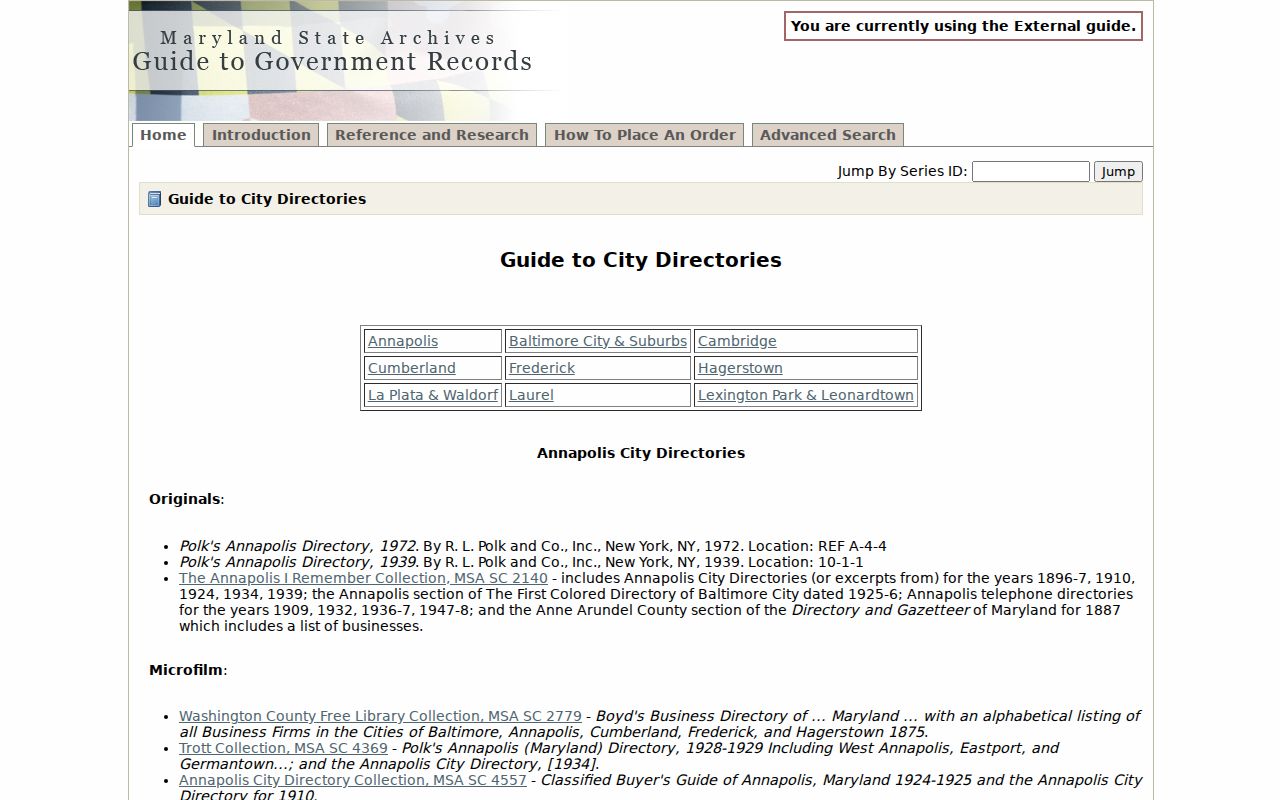
No standalone, continuous Suitland run appears in the official online catalogs. That fact actually helps. A missing local title is not proof a household was absent. The firm lead is Polk’s Laurel, Prince George’s County, Maryland City Directory for 1962. The Maryland State Archives guide, county library shelves, and Washington-suburban material form the practical starting points. Always check the title page before attaching any entry to Suitland.
| Collection | Years | Where Held | Access |
|---|---|---|---|
| Polk’s Laurel, Prince George’s County directory | 1962 located | Maryland State Archives directory guide | Confirm the item with MSA or PGCMLS |
| Washington Suburban and Prince George’s County material | Run not established online | Prince George’s County Historical Society and library catalog | Catalog and shelf request |
| Library of Congress U.S. directories | 1861-1960 collection scope | Library of Congress state and local shelves | Catalog-based research |
| HeritageQuest and census resources | Database coverage varies | Prince George’s County Memorial Library System | Library card access, subject to vendor terms |
County and metropolitan headings carry real weight here. Suitland is a CDP, not an incorporated city with its own clerk's directory shelf. Search the exact street, the surname, any former postal label, and headings for nearby communities. Write down what you searched. Include titles and years that came up empty. That way the next session avoids the same blind spot.
Note: A missing Suitland heading can reflect catalog scope, a different postal label, or an irregular publication run rather than a missing household.
Suitland City Directory Headings
Older research demands more than one place name. Suitland entries may sit under Prince George’s County, Washington Suburban, Laurel, District Heights, Silver Hill, or a postal city. The older village, the Census place, the ZIP delivery area, the voting geography, and the parcel description each work as a different key. A compiler sometimes filed households under a metro heading. The family itself said Suitland.
Use the street and number as a second check. That helps whenever an alphabetic entry carries a common surname. For the older road, search Silver Hill Road under its earlier documented names, Old Road and Alexandria Road. Paving came in 1932. Widening came in 1965. Those two dates make useful dividers when you move between maps, directories, deeds, and newspapers.
Suitland City Directory Leads
The 1962 Polk’s Laurel lead is specific. It should not be stretched into full Suitland coverage. Inspect its community scope, publisher statement, and entry format first. The Library of Congress directory guide explains that many volumes list names, addresses, telephone information, and occasional family or business clues. Compilation and coverage were irregular.
| 1861-1960 | The Library of Congress U.S. city-directory collection provides national context under state and local headings. |
|---|---|
| 1962 | Polk’s Laurel, Prince George’s County, Maryland City Directory is the confirmed Maryland State Archives lead. |
| Unresolved run | Washington Suburban and county volumes are referenced locally, but a continuous Suitland publisher and year run was not located online. |
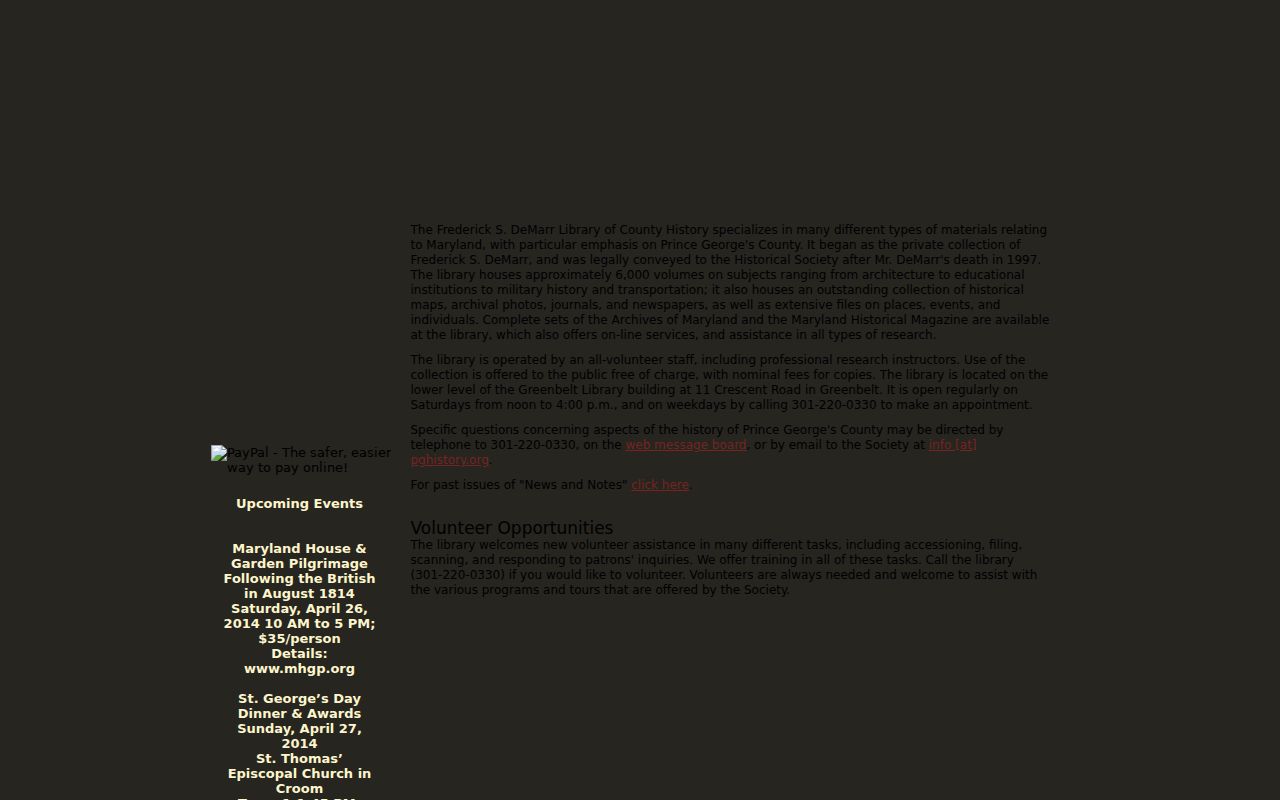
The Prince George's County Historical Society's DeMarr Library fills gaps that online search leaves behind. Its holdings run to about 6,000 volumes. The collection also includes maps, photos, periodicals, newspapers, and person, place, and event files. The library sits in the Greenbelt Library lower level. Hours are Saturday noon to 4 p.m., with weekday appointments available. Nominal copy fees may apply. Bring your address variants and an approximate year rather than asking staff for one universal Suitland directory.
The Historical Society library page shows the county-history collection and its access information.
Suitland Directory Research Rooms
The PGCMLS Maryland Room holds local genealogical and historical magazines and journals. It also holds 169 historic-site and house photographs. Ask specifically for county directories, obituary indexes, yearbooks, newspaper microfilm, and address-based material. The published page offers no complete directory shelf list. Staff and the catalog therefore form part of the access route rather than a last resort.
The Sojourner Truth Room at the Oxon Hill Branch opens another county path. It focuses on African American history and local-town material. When a conventional city directory omits a family, its catalogued items can be read alongside church records, census, MSA freedom records, deeds, and newspapers. At the state level, the Maryland State Archives provides directory guides together with land, probate, church, and freedom-record series. Archive staff and the search room are the right fallback for any catalog entry that cannot be inspected online.
Bring a written request listing name variants, street spellings, nearby place labels, and the years already checked. Ask whether the title has a street section. Ask about a reverse index, a separate telephone book, or a companion newspaper file. If staff locate a volume, photograph or transcribe the title page and abbreviation key before copying a single line. That step preserves the context needed to compare a Suitland result against a county or metropolitan heading later.
PGCMLS Maryland Room
Local history, magazines, journals, photographs, catalog help, and library databases.
DeMarr Library
County files, maps, newspapers, and periodicals in Greenbelt, with appointments on weekdays.
Maryland State Archives
Directory guides and historical series, with online and search-room routes.
Digital Suitland Directory Sources
PGCMLS online resources list HeritageQuest for city directories, family histories, genealogies, census data, and schedules. A library card opens most remote resources. Ancestry Library Edition works at branches rather than remotely, under the library’s stated conditions. The Washington Post archive spans 1877 to roughly 17 years before the present, making it strong for notices, obituaries, and community references.
The library’s digital genealogy resource page identifies the access conditions for these collections.

Digital access never replaces the shelf. When a result names a Washington-suburban volume without a clear Suitland section, compare its title page and place index at the library or archive before trusting it as local evidence.
Reading a Suitland City Directory
A historical Suitland city directory entry is only as strong as its source volume. Write down the title, publisher, year, community heading, and page number first. The line itself may list a surname, given name or initials, and a relationship notation. It may also show a street address and telephone details. Extra descriptors appear in some editions. Trust the volume's own legend. It defines what each mark means in that book, not in any other.
| Identity line | Preserve surname, given name, initials, and any relationship notation exactly. |
|---|---|
| Place line | Keep the street address and the printed community heading together. |
| Date clue | Record the publication year and any stated compilation date. |
| Legend mark | Photograph or note the volume’s key before assigning meaning to abbreviations. |
| Linkage | Compare adjacent years, a street section, census, deed, obituary, or newspaper item. |
- Criss-cross directory
- A street-order section that can turn an address into a listed name, only when that volume actually includes one.
- Householder index
- An index arranged around a household or address reference, not proof of every person present there.
- Abbreviation key
- The printed legend that explains terms such as “wid,” “r,” “h,” “apt,” or “rear” in that particular volume.
Note: A residence mark in a Suitland directory proves ownership only when the volume's own key says so.
Trace Suitland City Directory Households
Start with the Suitland directory year you know best. Then work outward, one volume at a time. A household that moves, drops initials, or vanishes entirely deserves corroboration rather than a guess. Census schedules from 1850 through 1950 add relationships, ages, birthplaces, and sometimes street data. The 1890 federal census was largely destroyed. So treat that gap as a gap, not as proof anyone left.
- Normalize the street name, number, directional, and suffix, then preserve the original spelling as a search variant.
- Find the nearest directory year under Suitland and nearby county, metro, or postal headings.
- Compare surname, initials, telephone information, and street line in adjacent volumes.
- Pair the dated entry with the relevant National Archives census guidance and record the census place heading.
- Use a deed, obituary, vital-record route, or probate source to test the relationship and time period.
To walk a Suitland address backward through time, the Suitland previous residents search pulls together deed references, historical indices, directories, and census records tied to one parcel. A current name or address still needs its own record before you rely on it.
Suitland City Directory Context
Local geography can explain a Suitland address that seems to disappear. The Census Bureau's Suitland history documents a 1941 federal-campus acquisition covering 437 acres and 12 residences. The Bureau relocated in spring 1942. A family displaced from that land may surface in maps, federal-campus references, local newspapers, deeds, and census geography. It may not appear in a directory line at all.
The Maryland Room at the Historical Society holds historic-house photographs and place files. These give a bare address line a human scale. Redevelopment erases buildings, but an image can preserve a facade, a caption, or a street clue. Its 169 photographs run from early county history into the mid-twentieth century. Many show places that no longer stand. They prove nothing about current use or occupancy. Even so, they can steer a family-history search toward the next dated source. Ask staff for the catalog record and image caption. Then compare the described place with maps and the directory's printed street form.
County history changes how a Suitland name is read, too. Colonel Samuel Taylor Suit bought land here in 1867. The early village grew around his store and post office. The 1909 Suitland Improvement Association shaped community identity. These facts explain why a family may appear under a village or community label. It may not appear under a modern postal designation. Use them as search aids, never as replacements for a dated directory or record citation.
The Maryland State Archives directory guide is the documented starting point for the confirmed directory lead.