
Suitland Previous Residents Sources
A Suitland house history is never one record series. The trail usually starts in Maryland's assessment data. From there it moves through recorded land instruments, then widens to directories, census schedules, newspapers, and archival material for past households. The land side is strong evidence of a transaction, but it cannot name every person who occupied the parcel. Historical sources carry their own gaps too. What you want in the end is a dated chain of evidence, not a single untested name.
| Source | Years It Covers | Where Held | What It Shows |
|---|---|---|---|
| SDAT assessment record | Current assessment presentation | Maryland SDAT property search | Parcel/account, situs, mailing address, owner field, and deed reference |
| Maryland Land Records index | PGC electronic guide begins 1950 | Maryland State Archives repository | Recorded parties, instrument, date, book/page, and images when available |
| Historical PGC land series | Series-specific, from 1696 onward | MSA guides and archival indices | Earlier grantor, grantee, court-land, tract, and plat leads |
| Directories and census | Irregular directories; census 1850-1950 | PGCMLS, LOC, NARA, Historical Society | Dated household and address clues |
| Permits and newspapers | System and title dependent | PGC systems, library, Historical Society | Building changes, notices, and time anchors |
One address is not one record. Begin at the official Maryland SDAT Real Property Data Search. It accepts Prince George's County plus an address, street name, property account, or map reference. That limit is deliberate. Public online searching by owner name, town, subdivision, neighborhood, or ZIP is not offered, and the constraint keeps the address trail tied to a real parcel rather than an assumed match.
Start With a Suitland Parcel
Pull the situs address first. That is simply the street location. Record the account or parcel identifier, legal description, map, block, lot, subdivision, and the Deed 1 or Deed 2 liber and folio. The owner line reflects the last deed. The mailing address is only where tax notices go. Neither field proves past occupancy. The stable bridge between records is the parcel or account number and the legal description.
Property cards often add a transfer date, consideration, tax class, and assessment values. Read the transfer date with care. A recording date may not match the settlement date, and the recorded consideration can be nominal or missing. Log those distinctions, then let PGAtlas confirm the parcel geometry and its map context, always checking the map back against SDAT and the land record.
- Situs address
- The physical street location of the parcel, which can differ from the owner’s mailing address.
- Parcel or account
- The assessment identifier that links the current record to mapping and county records.
- Legal description
- The recorded land description, often more stable than a street name in older work.
- Liber and folio
- The Maryland book and page reference used to locate a recorded land instrument.
Note: Keep the address in its exact original form before you normalize anything, since a changed directional or suffix can derail a match in older records.
Suitland Previous Residents Through Deeds
Deed research for Prince George's County runs through the Maryland Land Records Digital Repository. Setting up access takes an account plus an emailed two-factor code. Only one device may be signed in at a time. After that, searches and images cost nothing. You can query by county, party name, party type, instrument type, date, or book and page. The newest recorded instrument points you to the prior party worth checking next. Remember, though, that deed names document a transaction. They are not a household roster of past residents.
- Open the SDAT deed reference and locate the current instrument by book and page or the available party and date fields.
- Read the image and save the recording date, grantor, grantee, instrument type, legal description, and cross-reference.
- Search the earlier grantee as a later grantor, using a narrower date range when the name is common.
- Compare parcel language, tract wording, map and lot references before attaching the earlier deed to the same Suitland address.
- Move into the historical index path when the electronic search stops at the needed year.
A grantor conveys an interest in the land. A grantee receives it. Put together, these parties form a chain of title. It is the running sequence of recorded transfers for a parcel of land. That chain holds up only as far as the legal description. It ties each instrument to the next. When an image will not load or a certified copy is required, the Prince George’s County Circuit Court Land Records Department serves as a fallback. So do the Maryland State Archives search routes and the Archives’ certified-copy order channel. MSA posts a $35 nonrefundable fee for a hard-copy certified order. You must supply an exact citation.
Older Suitland Land Indexes
Never force a modern street address into an older index. Prince George’s County offers official historical paths instead. These include court land indices covering 1696-1840, land-record indices for 1851-1924, related nineteenth-century series, a grantor index spanning 1884-1949, patent and tract indexes reaching back to 1658-1975, and plat references for 1699-1879. Which series fits depends on the period and on the kind of land description the deed preserves.
When an address comes up empty, try tract names, adjoining landowners, road descriptions, plats, and survey references. This matters because early records carry no modern Suitland CDP label. The online index is not the only channel for the residents directory crowd. MSA guide entries, the Archives search room, and the Circuit Court records office can all help pin down the right retired or historical index. A written Maryland Public Information Act request may obtain an existing record from its proper custodian, subject to exemptions and fees. It cannot force an office to build a new chain of title from scratch.
Suitland Previous Residents After 1950
The electronic Prince George’s County land-record guide starts at 1950. Anything earlier may still demand the historical and retired indices. Even an address that looks fully modern can fall in that gap. Maryland’s Fall 2025 system overhaul brought a new account with email verification. It also added merged corporation and last-name searching, name modifiers, and revised index navigation. Old MDLandRec links now redirect into the new repository.
Maryland State Archives also reported a 2024-25 initiative converting PDFs of Prince George’s County land-record filings from 1950 through 1970 into text-searchable form. That is a real gain for discovery. It does not, by itself, make an extracted name reliable for a resident lookup. Read the recorded image, confirm the parcel description, and keep the citation. The project never replaced a title examination. It also never turned a recorded party into a proven past resident.
Suitland Previous Residents in Census
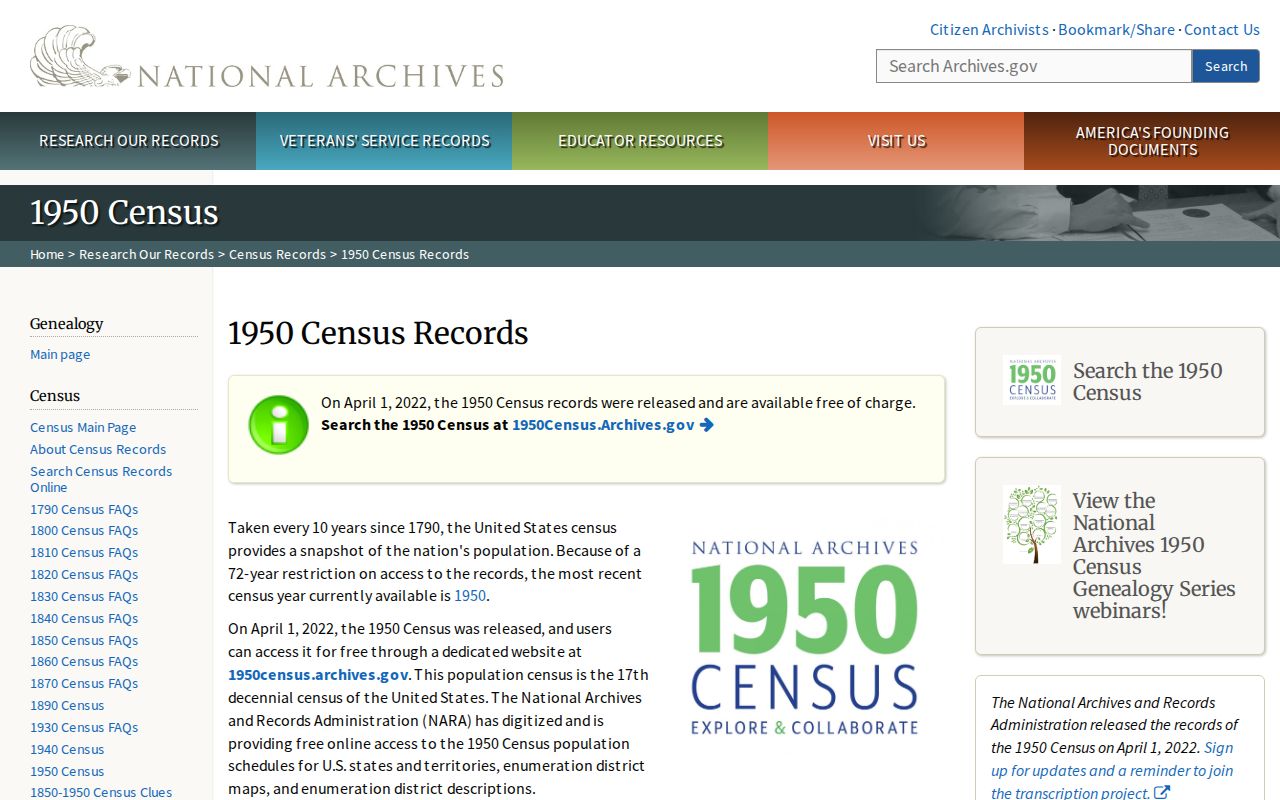
A dated household source gives past residents of Suitland their clearest anchor. The National Archives 1950 Census is free to search. It returns names, relationships, ages, birthplace, and street or address details. The 72-year release rule is why no later schedule is public yet. Earlier years depend on the access route. The 1890 federal census was largely destroyed by fire.
The National Archives 1950 Census search provides the documented online starting point for a historical household check.
For a printed snapshot, the Suitland directory book holds the confirmed Polk's Laurel lead and Washington-suburban material. It also lists library databases and shelf-verification steps. A street directory can place a name at a printed address. Just remember the books are irregular. Compilation sometimes happened well before publication. When a directory goes quiet, the Washington Post archive through PGCMLS can close the gap. Historical-society clippings, obituaries, and church records help too, so silence never counts as proof.
Suitland Previous Residents Road Names
Road names shift over time, and that changes any Suitland street directory search. Silver Hill Road once carried the names Old Road and Alexandria Road. It was paved in 1932. A widening followed in 1965. When a result vanishes at a date boundary, run all three names through deeds, maps, directories, and newspapers. Suitland Parkway, opened for military use in 1944 and placed under National Park Service administration in 1949, is one more geography clue for a changed tract or development pattern.
The Census Bureau's Suitland Federal Center history adds address-level context of a different kind. In 1941 the United States acquired 437 acres there. The taking covered 12 residences, farm or dairy land, and a small airfield. The Bureau arrived in 1942. A former house near that land may surface more clearly in maps, federal references, county histories, or newspapers than in any conventional address index.
Suitland Previous Residents Permit Trail
A permit trail can pin down when a building changed. It will not name the household. Prince George's County LookSee takes a reference number. It also accepts a street number with a street name. Its current Momentum system covers most permits dated on or after May 1, 2023. Legacy ePermits holds the older activity. It asks for house or building number, street name, ZIP, and a CAPTCHA. Utility, cell-tower, environmental, and well or septic categories carry stated exceptions. So a blank result calls for a channel check.
Record the reference number, permit type, application date, issue date, status, and the system used. For copies not online, an existing Department of Permitting, Inspections and Enforcement MPIA request works. A permit can date construction, alteration, inspection, or a case. Its listed applicant or owner still is not evidence anyone lived there.
Evidence Limits for Suitland Households
Keep past household research tied to family history. Estate and heir questions count too, as do neighborhood history and similar lawful personal purposes. Public records spot people in roles. A deed party, assessed owner, directory entry, or census subject each tells one story. None of them builds a full roster of everyone who lived at a Suitland address. Flag conflicts openly. A postal city can differ from a CDP. An owner can carry a separate mailing address. A directory can sit under another community heading.
Lawful use. Use historical records to document an address trail, not to watch, harass, threaten, or expose a protected person. Maryland Safe at Home and court privacy procedures can withhold or substitute an address.
Maryland Safe at Home gives qualifying survivors a substitute address and free mail forwarding. Court address-privacy forms shield qualifying participants, and confidential voters stay out of the public lookup. A missing result may simply mean a protected address. It may also point to an index cutoff, a spelling quirk, or a boundary difference. Silence never proves someone did not live in Suitland.