
Suitland Neighbors by Block Source
Different public sources answer different questions about a Suitland block. PGAtlas supplies parcel geometry and local map layers. SDAT holds the assessment record attached to each parcel. Maryland Land Records carries the recorded instruments behind it. Community groups can add local color, though no membership roster should be treated as public. A voter record is a narrowly limited way to confirm one individual. It is not an anonymous block directory. Decide first what the question really is: parcel boundaries, recorded ownership, a dated change, or neighborhood history. The answer determines which source fits.
| Source | What It Shows About a Block | Access |
|---|---|---|
| PGAtlas and PGC GIS | Subject and adjoining parcel polygons, roads, planning, and ZIP layers | Online map, then verify in SDAT |
| Maryland SDAT | Owner field, situs, mailing address, parcel/account, and deed reference | County and address, street, account, or map search |
| Maryland Land Records | Recorded parties, instrument, book/page, date, and available images | Free account with email verification |
| PGC permits and LookSee | Dated permits, licenses, or cases keyed to address or reference | Current and legacy systems have different coverage |
| Directories and census | Historical household clues near an address or street | Library, archive, and National Archives routes |
Recorded owner, mailing address, and current occupant are three different things. A parcel can carry an owner whose tax mail goes elsewhere. A Suitland mailing label may not match the Census place. A careful resident lookup describes the source and its date. It does not assert an unverified household. Say what the record shows and stop there.
Map Suitland Neighbors by Parcel
PGAtlas is the practical first viewer for the subject parcel and its block. Find the address or parcel. Then switch on parcel boundaries, road centerlines, ZIP, neighborhood, and planning layers. Note the parcel ID and legal street location for the subject and every adjoining polygon. GIS geometry shows which parcels sit nearby. It does not reveal a shared household, a mailing address, or a current owner. A shared edge is only a starting clue.
- Enter the known address and confirm the subject parcel’s map position.
- Click each touching or nearby polygon and save its parcel ID, street location, and map context.
- Search each parcel separately in SDAT using its address, account, or map reference.
- Use the SDAT deed reference to find a recorded instrument in Maryland Land Records when the question needs a dated transfer.
- Keep a layer date or layer name when it is displayed, because GIS and tax data can update on different schedules.
The parcel-by-parcel detail sits on the Suitland street directory page. For a neighbor lookup in Suitland, the immediate block is the right scope. Each parcel stands on its own. So treat every address as a separate entry in the residents directory rather than assuming households connect.
Note: A map layer can show a parcel relationship. That does not prove present occupancy or a personal tie between households.
Suitland Neighbors and SDAT
The Maryland SDAT Real Property Data Search needs Prince George's County plus a street address, street name, property account identifier, or map reference. It cannot be searched publicly online by owner name, town, neighborhood, subdivision, or ZIP. Every adjoining parcel must therefore go through its own address or parcel key. Building a block-wide name list is not what the tool allows.
Record the owner name as shown on the last deed, plus the mailing address, street location or situs, legal description, map, block, lot, and deed liber/folio. The situs is the physical property address. The mailing address is whatever the owner chose for tax correspondence, which may be an office or a different residence entirely. An own-occupancy code is an assessment field, never proof of who physically lives at an address.
- Parcel
- A mapped land unit with an assessment account and recorded description.
- Situs
- The physical location of the assessed property.
- Mailing address
- The address selected for tax correspondence, which may be different from the situs.
- Map, block, lot
- Land-reference fields that help tie a tax record to a mapped parcel and deed description.
Suitland Neighborhood Association Leads
Neighborhood names can point you toward local-history leads. They are not legal parcel boundaries or public household lists. Maryland's Sustainable Communities material names the Suitland Civic Association, Hillcrest Heights Civic Association, Fleischmann's Village Citizen Association, Dupont Village Neighborhood Watch, Hillcrest Heights Neighborhood Watch, and Creative Suitland. The county's Transforming Neighborhoods Initiative also lists Suitland among its named areas. Check the document date. Note the exact vocabulary too, before using any of those labels to interpret a block. Names shift over time, and boundaries in community documents rarely match parcel lines.
Suitland Civic Association
Community-history lead associated with the older Suitland Improvement Association, not an assumed member directory.
Hillcrest Heights Groups
Civic association and neighborhood-watch references that may help identify local terminology in plans or newsletters.
Fleischmann’s and Dupont Village
Citizen-association and neighborhood-watch names cited in the state community material.
The Suitland Sustainable Communities application is the source behind these references. Meeting minutes, archived newsletters, and a Maryland Public Information Act request matter only when a custodian actually holds an existing public record. Private member information should never be reconstructed or published.
Suitland Neighbors and Voter Data
Maryland's individual voter lookup requires first name, last name, date of birth, and a five-digit ZIP. Street number and middle initial are optional. It confirms a matching registration record and election districts. It is not a browseable Suitland roster, and confidential voters never appear. The service says it updates daily. Still, online or MVA updates can take up to three weeks to land.
A defined-area voter product takes a separate route. Use the Prince George's County Board of Elections product request or the State Board's own process. Filters can include county, district, precinct, ward, municipality, voter status, party, and selected election history. The request demands a written declaration under penalty of perjury. It stays limited to its stated electoral purpose, and restrictions bar commercial solicitation and non-electoral use. A block is simply not a voter-search category on its own.
Suitland Neighbors Permit Dates
Permit and code activity can date a change around a Suitland block. It does not identify any household. LookSee searches by reference number or by street number and street name. Options let you search or search all. Its reference patterns cover permit, license, and case numbers. The current Momentum system holds most records on or after May 1, 2023. Legacy ePermits keeps older activity and needs address elements and ZIP. Utility, environmental, well, septic, and other categories carry stated exceptions.
Confirm the address and reference-number options with the official LookSee search before starting any permit-history review.
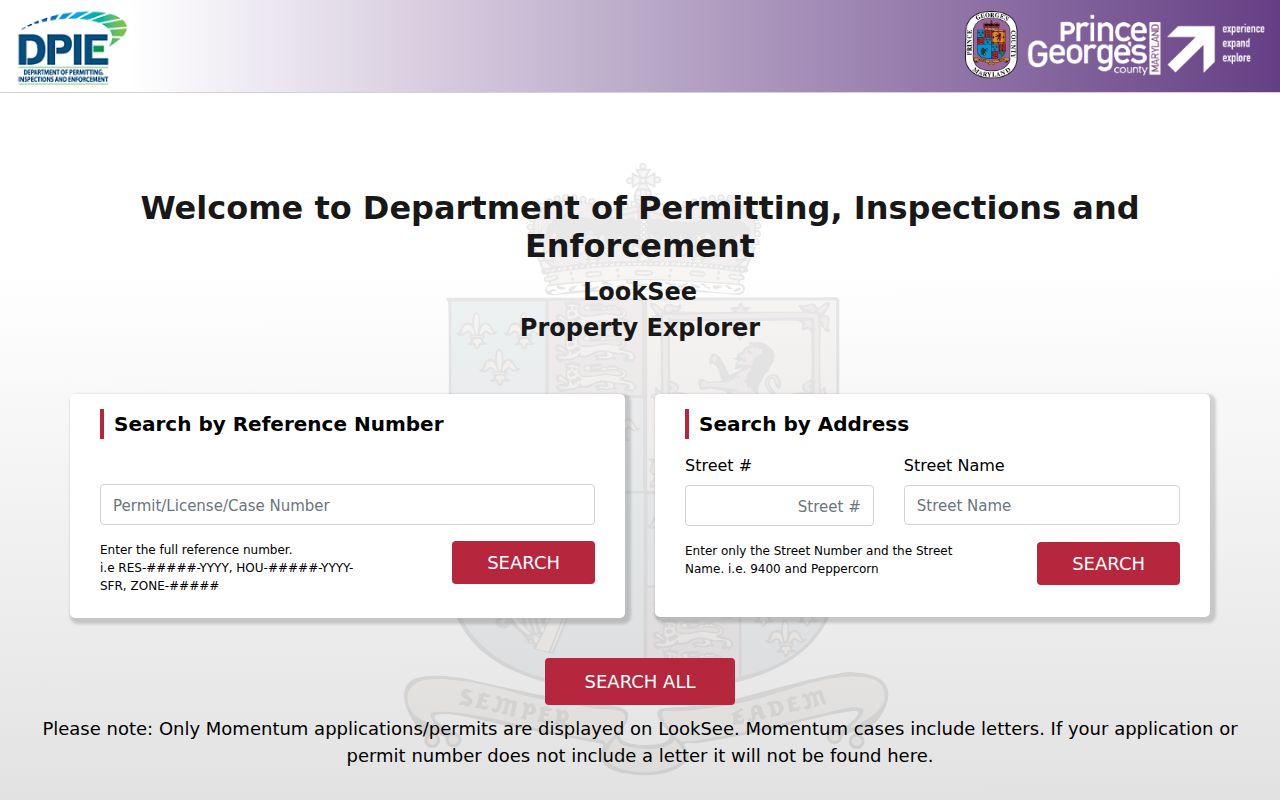
The permit screen works best as an address-history tool. Its results still demand record-type and date checks. You would apply the same ones to parcel, deed, or block research. Treat each permit's dates as time markers. The reference, type, application, issue, and status fields all help date an address, but the listed applicant, owner, or contact is not proof of residence. Copies come through a Department of Permitting, Inspections and Enforcement MPIA request. PGC's online systems, the records request, and the custodian counter each answer a different question. Note which channel supplied each fact.
Historic Suitland Neighbors
Older Suitland blocks rarely answer to one source. Pair the parcel with a directory or a census schedule. A map, a newspaper, or a photograph works too. No continuous Suitland reverse or criss-cross directory appears in official online sources. The PGCMLS Maryland Room, the Prince George's County Historical Society, and the Library of Congress directory collection remain documented access paths. The Maryland State Archives does too. A criss-cross section can turn an address into a listed name. Confirm the section exists in the actual volume first.
Silver Hill Road shows up as Old Road or Alexandria Road in older material. The 1932 paving and the 1965 widening make useful checkpoints. The 1941 federal-campus acquisition took 12 residences. Either event can explain why a familiar parcel narrative breaks. A historical photo or clipping makes a fine lead. Preserve its caption, publication date, and source.
One confirmed directory lead is Polk's Laurel, Prince George's County, Maryland City Directory. That volume covers 1962. PGCMLS also offers HeritageQuest for directories and census material. Ancestry Library Edition is branch-only under the library's stated access terms. The National Archives 1950 Census is free. Compare its result with the street heading, the parcel, and other sources. An enumeration place can differ from the modern Suitland label.
The Maryland Room holds 169 historic-site and house photographs. Many show places no longer standing. A single image can tie a block to a building or a caption. The Historical Society's place, event, and person files add newspapers and local context. Neither source proves a current household. Each can supply a citation or a spelling variant for the next archival search.
Privacy Limits for Suitland Neighbors
Official records define their own limits better than any commercial neighbor-search category does. An official map ties a location to its parcel. An assessment entry names an owner of record along with tax fields. A deed confirms that a transaction was recorded. None of these records confirms every person living at a Suitland address. Date cutoffs, confidential voter status, and court protections can leave them showing less than a reader expects. Separate mailing versus situs addresses can do the same.
| Official records | Show dated, source-specific facts that can be checked with the custodian. |
|---|---|
| Commercial category | May combine data of uncertain date or origin and should not replace a public-record check. |
| Protected information | Safe at Home, court privacy, confidential-voter, and other limits remain outside a parcel workflow. |
Lawful use. Use Suitland neighbor records for community context, family history, or personal safety awareness, never to stalk, threaten, harass, or expose a protected address.
Maryland Safe at Home gives qualifying survivors a substitute address and free mail forwarding. Court address-privacy procedures and confidential voter rules add their own limits. Never try to reverse-engineer those protections. An absent result can mean a protected address, a search mismatch, or a coverage limit. It is never proof about a person.
Maryland's Online Data Privacy Act guidance notes the law took effect October 1, 2025. Covered residents gain certain rights over covered personal data. Publicly available government information sits outside that statutory definition. The law erases no existing deed, court summary, voter record, or archive item, and it does not weaken the safeguards protecting confidential addresses.